
How to Search Cases by Name
Utah Courts XChange help documents the public search fields used for Rich County District Court and Rich County Justice Court case information. The official search-field capture appears below.
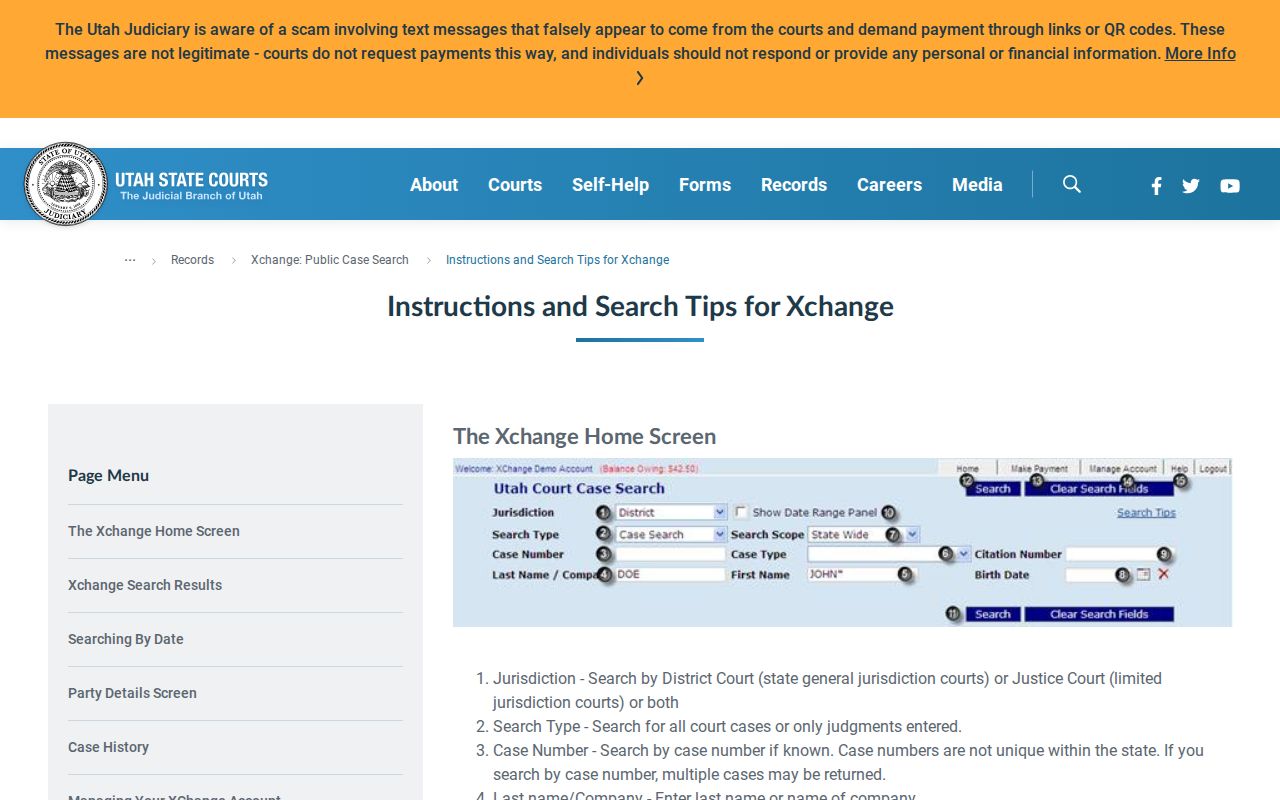
The displayed controls let a reader choose District Court, Justice Court, or both. The Last Name/Company box accepts a surname or business name. The First Name box permits a first-name prefix with an asterisk. Common names need a county, court, case type, or date filter because XChange displays no more than 500 results on a result page.
- Open XChange and select the likely jurisdiction.
- Enter the surname or company, then add a first-name prefix if useful.
- Narrow the scope to Rich County or a specific Randolph court location.
- Compare the result row before opening Case History/Documents.
| Field Label | Type | Required | Notes |
|---|---|---|---|
| Last Name/Company | Text | Search-dependent | Use the official wildcard guidance and try known spelling variants. |
| First Name | Text | No | An asterisk can follow a known prefix. |
| Jurisdiction / Case Type | Selector | No | District and justice records cover different matters. |
| Search Scope / Date Range | Selector | No | Limit by county, court, filing, disposition, or judgment dates. |
A result is only a possible match. Read the county, location, case type, filing date, name, and party code together. Businesses belong in the company field, and suffixes may vary. Each online search is billable, including a no-match search, so careful filters can avoid repeated paid attempts.
Rich County XChange Routes
The court level is the first useful filter. Rich County District Court holds felonies, class A misdemeanors, most civil matters, domestic cases, probate, judgments, torts, and property-rights cases. Rich County Justice Court handles traffic and parking matters, infractions, county ordinances, class B and C misdemeanors, and small claims. Selecting both jurisdictions is sensible when the case level is unknown, then Rich County can narrow the statewide set.
The official XChange fee page sets out guest, one-time, monthly, and government access options. Its captured fee choices are shown below.
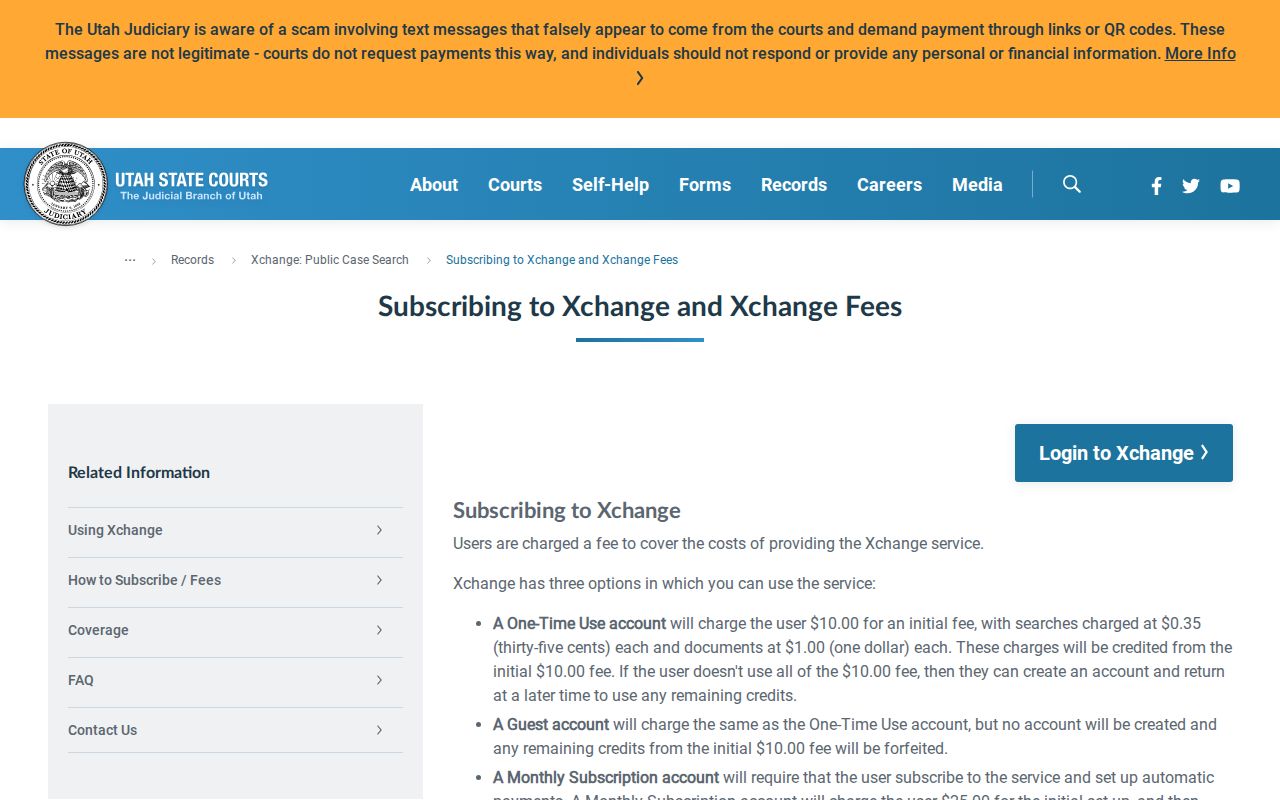
The fee screen matters because each billable search can cost money even when no case matches. Current research lists guest searches at $0.35 and documents at $1 each, while account plans use different terms. Verify the live page before purchase.
Search Type can cover all court cases or judgments only. The date panel can filter case filings, case dispositions, judgments, or satisfied judgments. Those choices answer different questions, so a judgment-date search should not be treated as a filing-date search.
XChange is the statewide public case-search layer. It is not a separate Rich County database, and the court location still must be checked.
How to Search by Case Number
Enter the full court-assigned number when it is known. A Utah case number is not necessarily unique statewide, so one number can yield more than one row. The first two digits generally point to the filing year, but that clue cannot identify the case by itself. Confirm Rich County, the Randolph court location, case type, filing date, parties, and judge before relying on the history.
For a party registering in MyCase, Utah's instructions call for an exactly nine-digit number with no letters, represented here only as #########. XChange accepts its Case Number field within a larger public search. Citation numbers require an issuing location because they also are not unique across Utah.
Rich County Case Type Codes
Case type is a strong cross-check when a number or name returns several rows. The Utah XChange case-code page publishes the categories used for Rich County court records. Its official code list is pictured below.
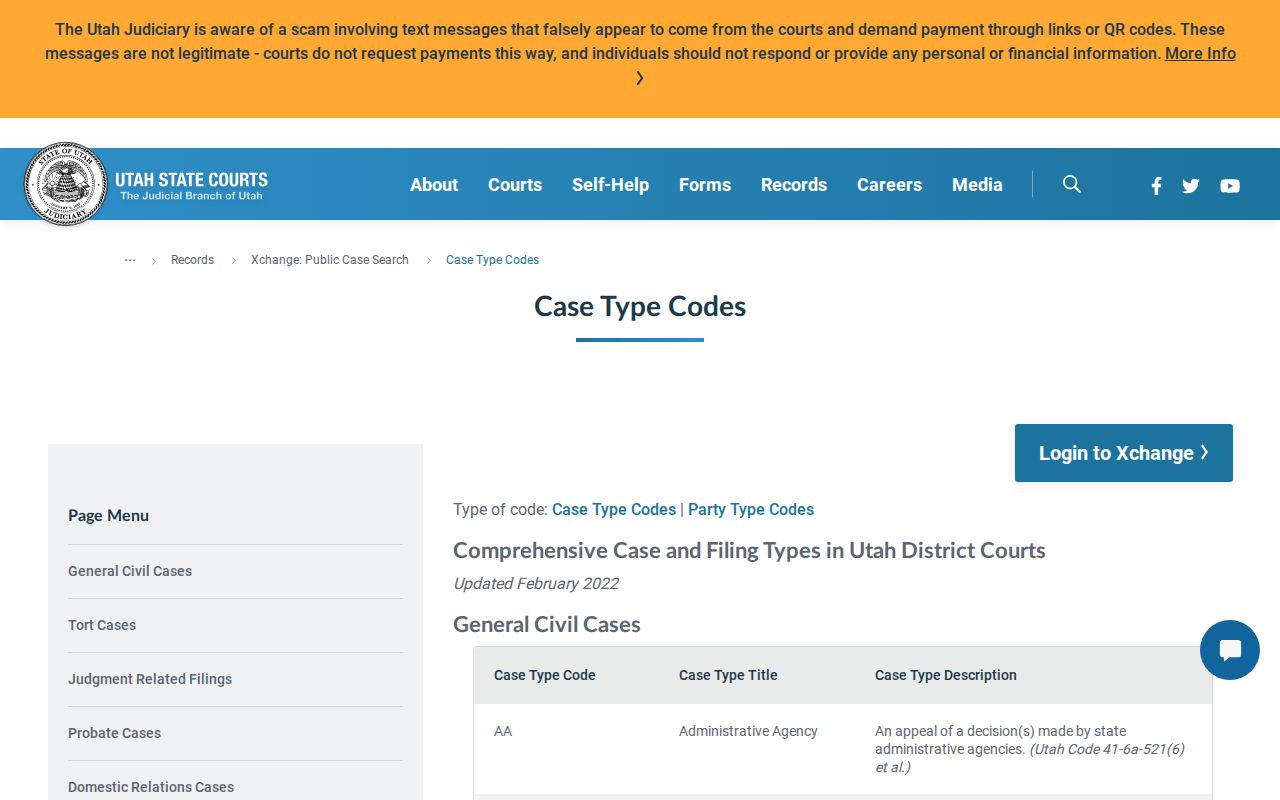
The code capture shows why a case type can distinguish otherwise similar search results. District examples include debt collection, eviction, contract, probate, property rights, judgments, tax liens, and felonies. Justice examples include small claims, infractions, traffic citations, and lower-level misdemeanors.
- TN / TC
- Traffic citation or traffic court case.
- FS / MD / MO
- State felony, misdemeanor DUI, or other misdemeanor.
- SC / EV
- Small claims or eviction. They do not route to the same court merely because both are civil.
- AJ / TL
- Abstract judgment or tax lien record.
Party codes also matter. PLA means plaintiff, DEF means defendant, PET means petitioner, and RES means respondent. The code describes the person's role, not the case result.
What a Case Search Shows
A Rich County result row can show county, court location, case type, case number, filing date, name, birth date when public, and party code. Opening the case number leads to expanded Case History/Documents. That view may add the judge, attorneys, charges, pleas, dispositions, citation data, chronological proceedings, judgments, and an account summary. A docket entry that says an order was signed does not guarantee that the order image is available.
| Case Number | Court identifier that must be checked with location and type. |
|---|---|
| Caption / Parties | Case title and public party-role codes. |
| Case Type | Criminal, civil, traffic, probate, judgment, or another Utah category. |
| Proceedings | Chronological filings, settings, orders, and outcomes that remain public. |
| Documents | Purchase controls may appear for exposed public document images. |
The case history is an index and chronology. Public district document images can be bought separately, generally for electronically filed documents since July 2010. Some public case histories have private underlying filings. The signed order or judgment held by the clerk controls over a short result label.
Rich County Records Since 2000
The XChange coverage table records a June 26, 2000 connection date for the Randolph district location. The official Rich County coverage row appears below.
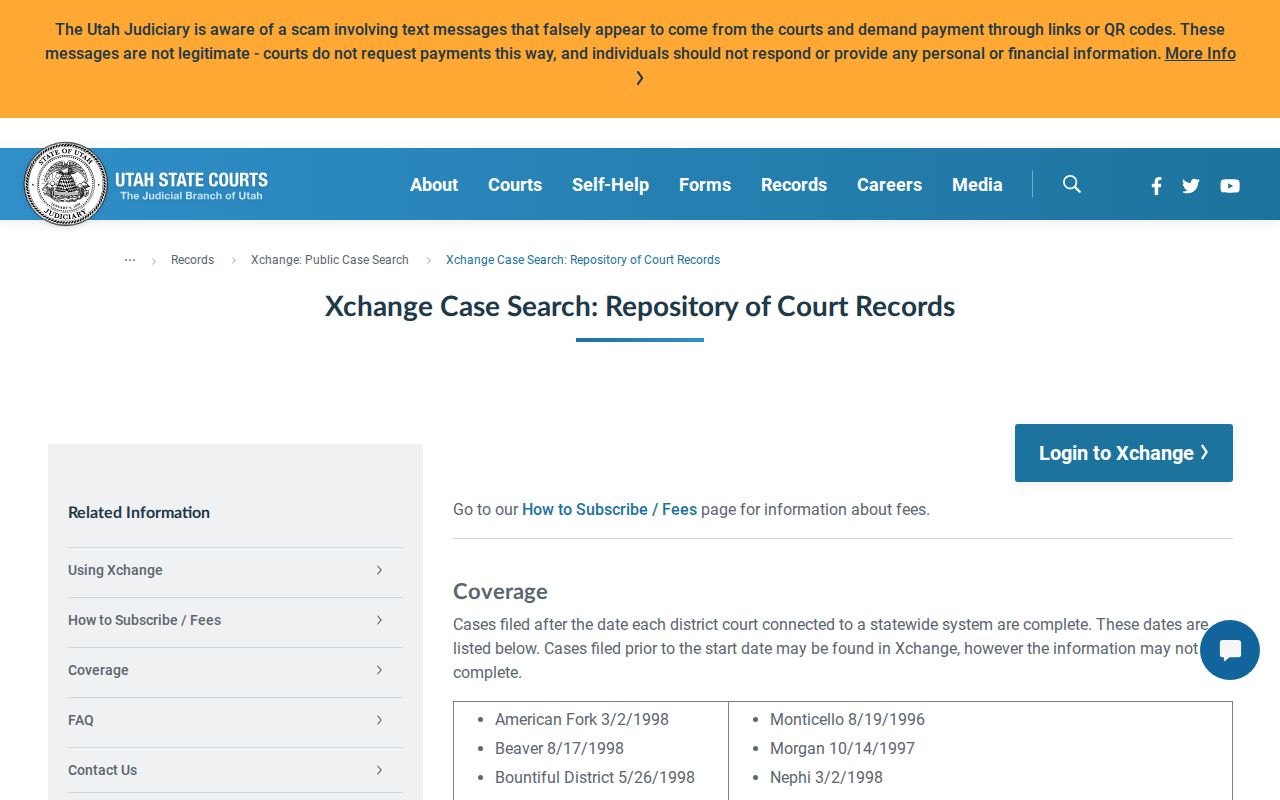
The captured row confirms the local connection date, but it does not promise that every older converted entry carries the same depth as a recent electronic case. A missing or thin online history may need clerk review.
Call the Rich County clerk at 435-793-2415 or submit a written Request for Record when an older file is incomplete. Describe the court, approximate dates, case type, and known identifier. The clerk can determine what exists and how it is classified.
County vs Statewide Case Search
Rich County has no separate county-run searchable case database documented in the official sources. XChange supplies the statewide district and justice court search, while the local clerk and courthouse provide the county-level fallback. MyCase serves parties in eligible matters. The Full Court Calendar answers hearing-date questions, and Utah eFile is for authorized filing rather than public lookup.
| XChange statewide search | Rich County local access |
|---|---|
| District and justice records across Utah | Clerk counter, phone, and written request for local files |
| Paid public search and purchasable documents | Free inspection may be available at a courthouse terminal |
| Best for names, numbers, codes, and statewide scope | Best for older, missing, certified, or classification questions |
A party seeking an eligible personal case can use MyCase after identity-based registration. It can show filed papers, case history, payments, and notifications. Public researchers should use XChange instead. A calendar search is best when the sole question is when and where a hearing is set.
Rich County No-Match Searches
A no-match can reflect spelling, an overly narrow date range, the wrong jurisdiction, a new citation not yet posted, incomplete older conversion, or a protected record. Broaden one field at a time. A citation fewer than five days old may still be entering the local system. Do not let a search delay override the response date printed on the citation.
If the matter is federal, use District of Utah PACER rather than Utah XChange. If it is juvenile, sealed, expunged, or private, ordinary public search is not the right route. A party may have access through MyCase or a rule-based request that a general public user does not.
Note: Online absence is not proof that a case never existed, and a calendar entry is not the full Rich County case history.
Rich County MyCase Party Access
Utah MyCase is designed for a party or authorized participant, not for a general public name search. Registration uses email, an exactly nine-digit case number, and government-issued identification. Eligible users may view their own case history and filed papers, link cases, pay amounts, and receive change notices.
Choose MyCase when identity and party status support access to an eligible personal file. Choose XChange for ordinary public research. A hearing participant does not need a MyCase account merely to join a remote hearing; use the official calendar link or call the court when no link appears.
Restricted Cases and Access Rules
UCJA Rule 4-202.02 classifies Utah court records as public, private, protected, sealed, or otherwise restricted. XChange omits sealed and expunged matters, juvenile delinquency, child-welfare, and termination-of-parental-rights cases. Domestic, adoption, guardianship, conservatorship, stalking, and related filings may receive special treatment even when limited public case-history entries remain.
Under Rule 4-202.04, a request normally goes in writing to the clerk. A requester seeking nonpublic material must state the legal basis and supply any required authorization or order. The Request for Record form asks for a reasonably specific description and does not guarantee release.
Ask the Rich County clerk for a classification decision. Do not try to rebuild a sealed or private case from scattered public references.