
Searching Rich County Criminal Dockets
Utah Courts XChange is the statewide repository for public District Court and Justice Court case history. Begin with the court named on a citation, notice, or order. Select District Court for a felony or class A misdemeanor, and Justice Court for most class B or C misdemeanors and infractions. A name can be broad, so add the first name, case type, county, court, or date range when available. Case and citation numbers are not unique statewide. Pair either number with Rich County or the known court location.
Online XChange use is fee based, while public access is free at most district courthouse terminals and at the Utah State Law Library. Call the Rich County courthouse at 435-793-2415 before travel to confirm the local terminal and counter route. A written Request for Record can seek a public item not exposed online. These channels serve different needs: XChange locates history, the calendar confirms settings, and the clerk supplies official copies.
- Choose District Court, Justice Court, or both in XChange.
- Set Rich County or the known location as the search scope.
- Enter a case number, or search a name with useful narrowing fields.
- Compare court, case type, filing date, and party role before opening history.
- Ask the clerk for the signed or certified record when the outcome must be authoritative.
Rich County Criminal Court Codes
Rich County searches become clearer when the case-type code is treated as a routing label. FS means state felony, MD identifies misdemeanor DUI, MO means other misdemeanor, and IF marks an infraction. Traffic and parking histories can use TN, TC, PN, or PC. The code describes the file category, not the final outcome.
FS State felony in District Court.
MD or MO DUI or another misdemeanor category.
IF Infraction, generally on the lower-court side.
TN or TC Traffic citation or traffic court case.
Use the official XChange case-code list when a label is unclear. Similar-looking disposition codes can mean different things.
Inside a Rich County Criminal Docket
An expanded XChange history can identify the court location, case type, assigned judge, parties, attorneys, charges, plea and disposition fields, and chronological proceedings. It may also show a citation number, violation date, agency, officer, prosecutor, and an account summary. An allegation is not a finding. Read the disposition and judgment entries, and obtain the signed document when exact terms matter.
| Case number | Utah identifiers often begin with the filing-year digits; MyCase registration requires a nine-digit number. |
|---|---|
| Charges | Description, level, special attribute, and charging agency when public. |
| Settings | Arraignment, pretrial, compliance, plea, trial, or sentencing events. |
| Plea | Date and nature of the recorded plea, distinct from disposition. |
| Disposition | Date and result for a charge or case component, followed by judgment or sentence where entered. |
Rich County Criminal Filing Context
Official fiscal-year 2023 statistics recorded 23 Rich County District Court criminal filings and 23 dispositions. The filings comprised seven state felonies, nine other misdemeanors, and seven misdemeanor DUI matters. The disposition counts were eleven, ten, and two in those groups. Those figures describe yearly workload, not a live docket or a claim about any person.
A filing and a disposition counted in the same year need not belong to the same case. Older matters may close while newer ones remain pending. Use the individual history for case status.
How a Criminal Case Moves
A public history may begin with a complaint, information, or citation and then record filing, arraignment, plea, bond, motions, orders, and settings. A plea or trial can lead to dismissal or another disposition, followed by sentence, judgment, payment, restitution, appeal, or transfer entries. Not every case takes every step, and a reset does not erase the case.
Rich County docket flow: Charge Filed › Arraignment › Pretrial Settings › Plea or Trial › Disposition › Judgment
Rich County Pleas and Outcomes
Plea, disposition, and judgment are separate entries. A plea records the response to a charge. A disposition records how a charge or case component ended. Judgment sets the court's enforceable determination. A plea in abeyance, shown by PA or AP in some contexts, holds an outcome under stated conditions. Deferred traffic prosecution has its own DT path. Neither label should be casually rewritten as a conviction.
An online line item may say that an order was signed without offering the PDF. Review the official judgment and disposition list, then request the signed order from the clerk if its terms control an obligation. XChange history alone is not a certified disposition.
Courts That Hold Criminal Dockets
The Utah District Court, First Judicial District, Rich County location handles all Utah felonies and class A misdemeanors. Rich County Justice Court handles most class B and C misdemeanors, infractions, traffic, parking, and county ordinance matters. Juvenile cases follow the First District Juvenile Court route and do not appear as ordinary public XChange results.
Both adult trial-court levels feed public information to XChange when classification permits. The Rich County Courthouse at 20 South Main in Randolph is the local clerk route. Deputy clerk Shantel Jensen is listed for both District and Justice Court, so callers should name the division and case type. The official Rich District calendar and Rich Justice calendar help identify an upcoming setting. The separate Rich County court dates resource explains those calendar fields.
Missing Rich County Criminal Results
A missing result can have several causes. Sealed, expunged, juvenile delinquency, child-welfare, and termination-of-parental-rights records are excluded from ordinary public XChange search. A common name may be beyond the 500-result display cap. The Randolph District location connected to XChange on June 26, 2000, so older converted files can contain less detail.
Check spelling, wildcard use, court level, location, and date range. Then call the clerk. A person entitled to nonpublic material must use the written request route and state the legal basis, with authorization or an order when required. Public absence does not prove that no record ever existed.
Rich County First District Programs
Utah's First Judicial District serves Rich, Cache, and Box Elder counties, but the official problem-solving court directory does not list a separate Rich County specialty-court docket or local application portal. A Rich County criminal case can still include a specialized setting, supervision term, or program-related disposition administered through another First District location. That possibility does not create a new public case type. Search the underlying District Court or Justice Court history first.
The distinction protects against a misleading search. Statewide program descriptions explain collaborative court calendars that can involve treatment, supervision, and repeated judicial review. They do not establish that a named person is eligible, enrolled, transferred, or heard on a special Rich County calendar. Sensitive treatment information can also be restricted even when the ordinary public docket shows a generic hearing or disposition. The clerk or the identified First District program location should verify where a specific public setting belongs.
When a case history shows an unfamiliar program entry, read the surrounding settings and disposition rather than guessing from the label. Confirm whether the entry belongs to the Rich County trial case, a transfer, or a separate First District calendar. Request the signed order if program terms affect the case. Public docket shorthand cannot establish confidential treatment details, compliance status, or eligibility criteria that the court has not released.
The official Utah problem-solving courts directory shows the First District locations available to the public.
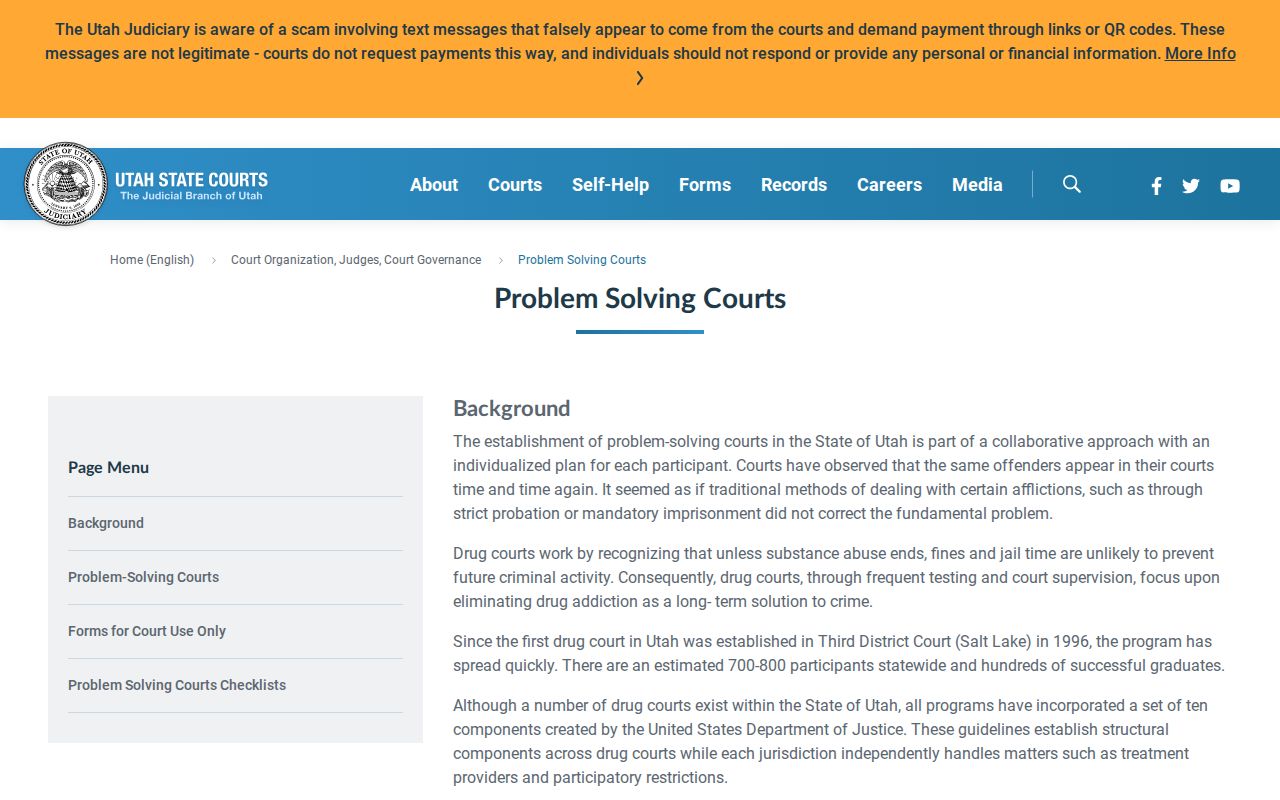
The directory supports careful routing, not a claim that Rich County operates its own drug, veterans, mental-health, or DUI docket. Federal CM/ECF is not shown here because it is a separate federal filing system and does not contain Utah state criminal cases.
Sealed Dockets and Public Access
Utah court records are presumed public unless a rule, statute, or court order classifies them otherwise. Public access can include case history and public hearings without exposing every filing. Rule 4-202.03 allows any person to inspect public court records, while sealed and expunged material requires recognized authority. Written requests go to the clerk under Rule 4-202.04.
Key Rules:
UCJA 4-202.02 classifies public, private, protected, sealed, and other court records.
UCJA 4-202.03 governs who may access each class.
UCJA 4-202.04 sets the written request process.